Wednesday, May 15, 2013

Happy 60, George Brett


Here's to George Brett, my all-time favorite KC Royals player, who turns 60 today.

George storms the field.
In honor of the day, let's go down memory lane. It's crazy, but it was 30 years ago this season that George Brett and pine tar became one and the same.

George smacked a two run home run in the top of the ninth inning, which gave the Royals a one-run lead. The umpire, however, after being alerted by the Yankee's manager, ruled Brett out for having too much pine tar, which would have caused the Royals to lose the game.


The Royals protested, the homer was restored.

It has become the "Pine Tar Incident" ever since.

And, 30 years later, the Royals are doing pretty well -- only 2 1/2 games out of first place.

Kaci and Brett, right. Yes, they are named after my favorite baseball team - The Kansas City Royals. Both are Royals fans. This picture is from a game last season.


Wednesday, May 1, 2013

May Day! May Day! May Day is a fading rite of spring


It might be the only day it’s appropriate to knock on your neighbor’s door and dash away.

However, you have to be quick.

It’s a tradition I grew up with here in rural Kansas. My mother and I would make cone-paper baskets and fill them with fresh-cut flowers from around our home, as well as homemade cookies. I’d creep up to the neighbors’ doors and ring the bell and hide, thinking they surely couldn’t fathom that it was the little, brown-haired, four-eyed girl from next door who had left them a gift each May 1.

Yet fewer children these days know of the tradition of leaving a construction-paper basket filled with flowers and cookies on someone’s doorknob then running for cover.

The centuries-long spring custom of May Day, it seems, is fading away.

“It makes me sad it might be a custom going in fashion,” said Karen Madorin of Logan, who recently talked about the disappearing annual rite on her blog and during her Saturday program on High Plains Public Radio. “It’s a tradition I had growing up.”

The May Day tradition, after all, is steep in history – the reasoning for the celebration lost years after our European ancestors first settled here, she said. She grew up knowing a little about its rich roots, that it was related to the Gaelic festival of Beltane – a pagan celebration honoring the beginning of the pastoral summer. And, according to several historians, the day is half a year from Nov. 1, another day of neo-pagan festivities.

Historians also associate it with other pre-Christian festivals, such as the festival for Flora, which honored the Roman goddess of flowers.

However, because the Puritans of New England considered May Day to be pagan, “They forbade its observance and the holiday never became an important part of American culture,” according to the 

Encyclopedia Britannica. In the late 1800s, May 1 in many countries honored International Workers Day and the fight for workers rights, including an 8-hour workday.

Nevertheless, the tradition still stayed with some families as they migrated to America and the Midwest. But in my quest to find people who still celebrate, it became difficult. However, I was amazed at the many memories people shared and the excitement in their voices as they recalled the tradition.

Those memories are still being made at my house.

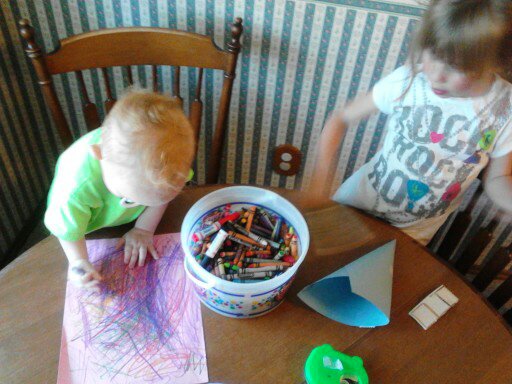
On Monday, my 6-year-old twins, my 1-year-old and I made May Baskets out of construction paper. With the cold April, there are no flowers blooming in my yard, but we baked cookies and the girls filled the cone-shaped baskets with candy.

On Tuesday, we began the tradition of knocking and running although the girls weren't too sneaky. They squealed as they ran from each doorstep - running just far enough away so they could see each neighbor receive his or her gift.

As I watched my girls, the event reiterated something Madorin told me in our phone interview. Put the history of the day aside. It doesn't matter if May Day has a lengthy Paganism tradition or that it has strong political meaning in some countries. May Day is about giving. It's about showing friendship. It's about doing it because you want to, and not expecting anything in return.

But as we walked home from our first day of May Day basket giving, one of our neighbors walked out of her home with her own homemade basket. She gave it to the girls as a thank you. She recalled her own May Day experiences and those of her children.

Maybe the tradition will be revived.

Brett and Kaci ready to deliver baskets.


Brett colors on her cone-shaped basket.

Jordie wants to try to make one, too.

Jordie is 1 1/2.

Kaci and Jordie making baskets.

Monday, April 29, 2013

Even in Hutchinson there is some "road rage"

Dear Ask Hutch:

This concerns 17th and Faircrest Drive. When you are gong west on 17th, it is two lanes when you stop at the light at Severance Street. Then, just west, you come to Faircrest Street on the right. Barely west of Faircrest 17th narrows to one lane.

Frequently, the vehicles in that right lane merge into the left and only lane - and so often it is not safely done. Why isn't there a sign east of Severance saying those in the right lane must turn right? There is a lane to turn right off Severance onto 17th when coming from the north. This is a dangerous place at 17th and Faircrest and a bad accident could happen and could be avoided.

I brought up the question here in the newsroom as I was trying to search out the answer. But the comments and discussion made us realize this is more than just an Ask Hutch question. Most agreed with the question asker. Jason immediately got riled up about the people "who jack wagon" into the left lane of traffic, cutting off the people who are in the "correct" left lane. Jim said he makes allowances for out-of-county and out-of-state tags, but added Reno County residents should know better.

There are other uniquely Hutchinson traffic problems, as well.

* 30th and Main - Head west on 30th past Main, and the same one-lane issue appears.

* Avenue A bridge on Main - Go south on Main past Avenue A, and many of us often get confused as to what lane ends as we're driving over the Avenue A bridge. Somehow, it always works out.

* Fifth Avenue near Dillons - One I hate the most, however, is probably Fifth and Adams by Dillons. The left lanes ends as you are heading west on Adams. If you're not in the right lane, plan on being patient.

If you're heading west on 17th, it turns into a one-lane road just past Faircrest.
* 11th and Plum - Even newbies soon have this one memorized. If you are heading west on 11th by the Cosmosphere, you have to be in the left lane, otherwise turn right on Plum.

* Hutch News Facebook reader, William Hirst, reminded me not to forget 11th Avenue and K-61. "What genius thought of that?" he writes.

Friday, April 26, 2013

Kansas State Fair's "Sunflower Shake"

Kansas State Fair took part in the "Harlem Shake" fad.

The fair posted a video this morning showing employee Denny Vick getting out of state fair tram in the fair's Expo Center show ring. He begins dancing and soon is joined by other fair staff. They called it the Sunflower Shake.

I am disappointed that I didn't see Fair Manager Denny Stoecklein in the video, although he might be hiding in the background. Assistant Fair Manager Lori Mulch Hart is posing as Dorothy from the Wizard of Oz.

The video ends with the maintenance crew continuing to "sweep up the mess" and the Oz characters holding the number "100."

The fair will celebrate its 100th birthday this year. You'll be hard pressed to find anyone who loves the fair more than me. I did cover the fair one week after giving birth to little Jordie, who attended her first fair in 2011 at 10 days old.

I rode the zip line, too.


Thursday, April 25, 2013

PETA talking of using drones to monitor hunters

As many of you know, I'm an avid hunter. Thus, it should be no surprise that my ears perked when I learned of this announcement released earlier this month by the People for the Ethical Treatment of Animals. PETA said it plans to watch hunters and farm operators using drones.

"PETA will soon have some impressive new weapons at its disposal to combat those who gun down deer and doves," the group said in a release dated April 8. " The group is shopping for one or more drone aircraft with which to monitor those who are out in the woods with death on their minds."

According to the group, they hope to catch people using spotlights, illegal baiting, as well as those drinking alcohol while in possession of a firearm.

PETA also intends to fly the remote-controlled aircraft over “factory farms,” fishing holes and “other venues where animals routinely suffer and die.”

PETA president Ingrid Newkirk says, “The talk is usually about drones being used as killing machines, but PETA drones will be used to save lives. Slob hunters may need to rethink the idea that they can get away with murder, alone out there in the woods with no one watching."

The animal rights group's announcement is coming when the talk of the government using drones to monitor farms seemed to be dieing down. Could it be another PR stunt similar to what the organization did just before the opening of the 100th Kansas State Fair?

Reno County hunting guide Jim Call says he doesn't care that PETA is using drones. In fact, it could be positive, Call tells me.

"I have nothing to hide," he says, adding that the effort could curb the county's poaching problem - something that has become worrisome over the past few years.

He said there are even area guides who are breaking Kansas hunting laws.
Future duck hunters.


Monday, April 15, 2013

Deep-fried guinea pig, anyone?

When in Peru, do as the Peruvians, right?

But the dining experience that requires trying to pull off a small morsel of meat from the carcass of a bony rodent that stared up at me with a toothy glare wasn't quite what I was after as my two-week adventure through Peru came to an end.

Last month, I journeyed to Peru as part of the Kansas Agriculture and Rural Leadership Class XI. Guinea pig was one of the many eye-opening experiences.

In America, we call these cuddly creatures pets. In Peru, especially in the rural areas, guinea pig is a vital source of protein  - especially in poorer, rural communities.

"Even the poorest family can afford to raise guinea pigs," Gloria Palacios, director of a small-livestock farm at La Molina National Agrarian University in Lima, told The Christian Science Monitor in 2006.

After all, guinea pig, or cuy, as the Peruvians call it, is a delicacy. They usually are cooked whole, the heads, feet and tail left on, then served to the diner. And, they aren't cheap, either. For roughly $64 sols, or about $30 American dollars, you can try guinea on your next Peruvian excursions.

However, according to this recent NPR story, the country wants to import more guinea pig into the U.S. food system. According to one U.S. newspaper, Peruvians eat more than 65 million guinea pig a year.

I'm a meat and potatoes person myself, but when in Peru, I figured I better act somewhat cultured. I also didn't want to disappoint my children, who were fascinated and somewhat repulsed by the idea. So, on one of our last nights in the country, five of us decided to order one guinea pig and split it.

My couple bites were a couple of bites too many. But, then again, I could see a new Kansas State Fair food for the 100th anniversary in September. Deep-fried guinea pig, anyone?

Guinea pig, anyone?


It seems happy, with that toothy grin ...


Saturday, March 30, 2013

Wilburton, A Morton County Dead Town


A stone at the Wilburton, Kansas cemetery. The stone says the cemetery was established in 1916.


Stones in the cemetery.


The first burial was Katherine Hesston Leake, who died in 1916. She was 30.

A few old outbuildings at Wilburton.


An abandoned bus

As several populated the area, a town was formed in 1912 halfway between Elkhart and Rolla. They named it Tice, the name of a high official of the Santa Fe Railroad. They platted out lots on 20 acres along what would eventually be the Santa Fe track.
But when a post office was built in 1913 by Mrs. Nellie D. Wilbur, the town became known as Wilburton, according to the history book.
At first, the train at Wilburton never stopped. The outgoing mail was hung on a high post near the track. When the train passed, the incoming mail was pushed out of the train and the out-going mail was grabbed from the pole.
Eventually, when area residents began to ship cream, hides and other products, the train would stop. The depot was an old boxcar that sat besides the tracks, the name Wilburton on a board across the top.
It didn’t take long for the little town to bustle with residents and commerce. Wilburton boasted two dry-good stores, two groceries, a church, garage, grain elevators, a feed yard, bank, lumberyard and florist. There also was a stockyard, boarding house, shoe repair shop and telephone exchange. The grade school and high schools had more than 100 students.
“The population of the town for many years was in the hundreds,” the book states. 

This Kansas Memory photo shows a dust storm passing through Morton County in the 1930s. Morton County, in the southwest corner of the state, was among the hardest hit areas during the Dust Bowl. Dust storms, such as the one depicted here, could blow for a full day, coating everything in their path with a layer of dirt.      


When 2-year-old Rena Coen died of dust pneumonia, the closest cemetery was covered in drifts of dirt.
So the Morton County farm family with seven sons buried their only girl in the Rolla Cemetery – just one of several causalities of the Dirty Thirties.
Her brother, Dale, now 91, recalls those days well, remembering how as a teen he would watch the billowing clouds of dust roll in, darkening the sky and leaving dust covering almost every foot of the family farmstead – a dust that was easily inhaled deep into the lungs.
It also blanketed the Wilburton cemetery.
“It was blowed under from the dust,” he said, adding the cemetery wasn’t well-kept, either. “A bunch of us boys, four or five of us, dug it out, got the markers dug out so the graves wouldn’t be lost.”
Wilburton, too, didn’t survive through the dust storms and the Great Depression. Today, only a few homes dot the prairie landscape where a thriving community was stood.